
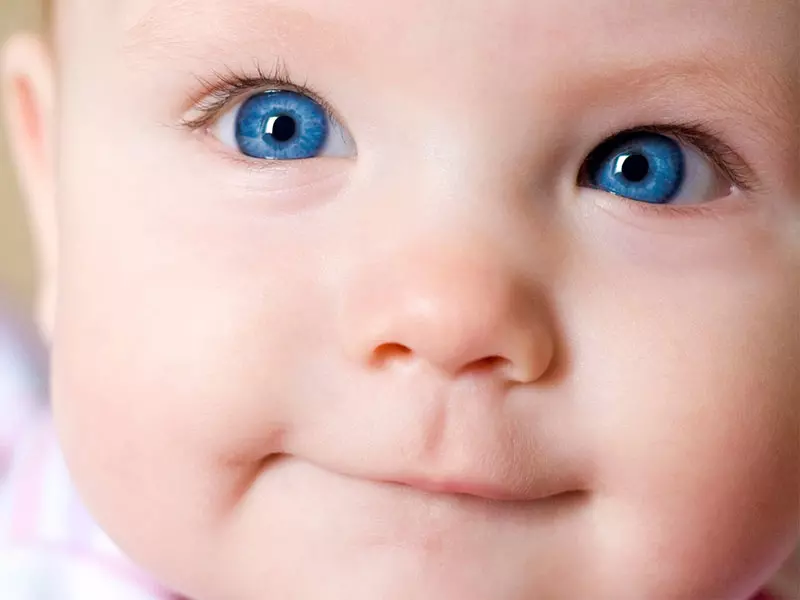
When Does a Newborn Baby’s Eye Color Become Clear?
As a new parent, it is completely natural to wonder what color your baby’s eyes will be. Eye color is one of your baby’s unique physical traits and can vary depending on many factors. In this article, we will explore the answer to the question “When does a newborn baby’s eye color become clear?” and take a closer look at this fascinating process.
What Is a Newborn Baby’s Eye Color?
Most newborn babies are born with blue or gray eyes. This happens because the pigment called melanin in the eyes has not yet fully developed. Melanin is the pigment responsible for giving color to the eyes, skin, and hair. Changes in a baby’s eye color occur as the level of this pigment gradually increases.
Having blue or gray eyes at birth does not mean that this will be the baby’s permanent eye color. This initial color is usually temporary until melanin production increases. During the first few months, the eye color may change, and the final shade may take up to one year to fully develop.
Each baby’s eye color becomes clear at a different pace. This depends on several factors, including genetics and environmental influences. For this reason, it is difficult to provide an exact timeline for when a baby’s eye color will be completely determined.
When Does a Newborn Baby’s Eye Color Become Clear?
A baby’s eye color usually begins to change within the first six months. The answer to the question “When does a newborn baby’s eye color become clear?” may take more than a year for many babies. During the first six months, eye color can change frequently, and parents are encouraged to observe these changes.
In the first few months, you may notice subtle shifts in your baby’s eye color. For example, blue eyes may gradually turn green and later brown. These changes are related to the increase in melanin within the eyes. In many babies, the eye color becomes more clearly defined by the end of the first year.
It is important to be patient during this process. Depending on genetic factors, the final eye color may continue to change until the child is three years old. Observing these changes can be an exciting experience for parents.
Factors That Affect Eye Color
A baby’s eye color is shaped by several different factors. The most significant factor is genetic inheritance. The eye colors of the mother and father play a major role in determining the baby’s eye color. However, because genetic combinations are complex, it is not always possible to predict the exact outcome.
Environmental factors can also influence eye color. For example, the amount of light exposure may affect melanin production, which can contribute to changes in eye color. During the first months after birth, babies’ eyes are more sensitive to environmental influences, making color changes more noticeable.
Nutrition may also play a role in the development of eye color. Some believe that babies who are breastfed may experience eye color changes more quickly. Breast milk supports the baby’s overall growth and development and may also contribute to the gradual development of eye color.
The Role of Parents’ Eye Colors
The eye colors of the mother and father can provide clues about the newborn baby’s eye color. Genetic traits play a crucial role in determining eye color. However, the process cannot be predicted with complete certainty because of the complexity of genetic inheritance.
If both parents have brown eyes, there is a higher probability that the baby will also have brown eyes. However, children of parents with blue or green eyes may still develop different eye colors. Genetic inheritance forms a complex combination, making precise predictions difficult.
In some cases, even the eye colors of grandparents can influence a baby’s eye color. When the family tree is considered, predicting a baby’s eye color can become even more interesting. Ultimately, the influence of genetics makes each baby’s eye color journey unique.
Changes in a Newborn Baby’s Eye Color
A baby’s eye color may start changing shortly after birth. Within the first six months, blue or gray eyes may gradually turn darker as melanin production increases. During this period, eye color changes may become clearly visible and can be exciting for parents to observe.
During the eye color change process, babies’ eyes may react differently to various lighting conditions. Temporary color variations may become more noticeable due to environmental factors. At this stage, patience and observation are important for parents.
It is difficult to determine exactly when eye color changes will completely stop. For most babies, the final eye color becomes clear by around one year of age. However, in some cases, eye color may continue to change until the child is three years old. Watching how your baby’s eye color develops during this time can be a memorable experience for parents.
Common Misconceptions About Baby Eye Color
There are many misunderstandings and myths about baby eye color. For example, some people believe that a baby’s eye color becomes clear immediately after birth. However, this is not true. Eye color usually changes gradually and often becomes stable within the first year.
Another common misconception is that eye color depends only on the parents’ eye colors. Although genetics plays a major role, environmental influences and additional genetic variations can also affect the process. Therefore, predicting eye color solely based on the parents’ eye color may not always be accurate.
Finally, some parents believe that their baby’s eye color will keep changing indefinitely. In reality, eye color changes occur only for a limited period and usually stabilize by around three years of age. Understanding and observing these changes can be both informative and enjoyable for parents.
 Call
Call
 Whatsapp