
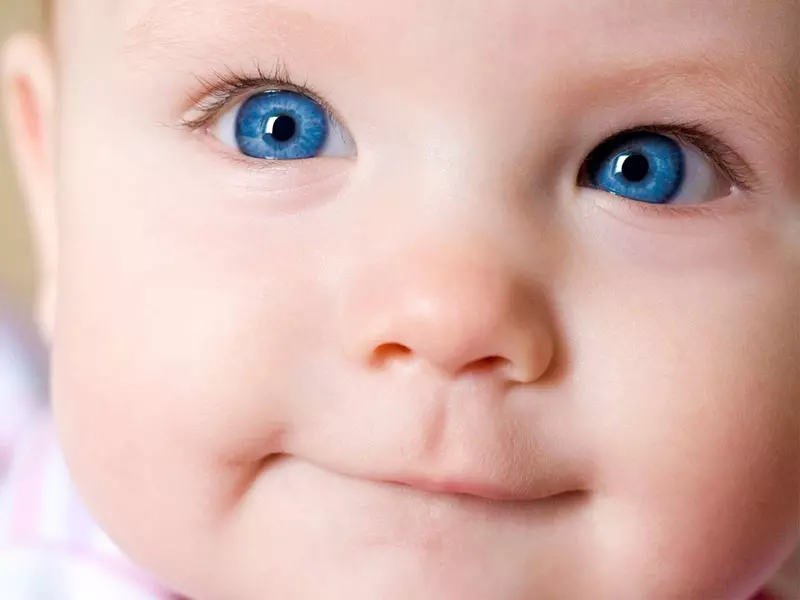
How Can You Tell If a Baby Will Have Blue Eyes?
It is completely natural for parents to wonder whether their baby will have blue eyes. Most parents try to predict which physical traits their baby will have in advance. How can you tell if a baby will have blue eyes? To answer this question, it is necessary to rely on genetic science. Eye color is determined by genetic factors, and different combinations of alleles influence eye color.
Predicting a baby’s eye color requires understanding the basic science behind eye color. Blue eye color is controlled by a recessive gene. If both parents have blue eyes, the probability that the baby will also have blue eyes is quite high. However, this is not completely certain, as genetics can sometimes produce unexpected results.
There are two main pigments that determine eye color: melanin and lipochrome. As the amount of melanin increases, eye color becomes darker. A lower level of melanin, combined with lipochrome, may result in blue eyes. Therefore, the genetic structure of the parents can influence the production of these pigments.
Eye Color Genetics and Blue Eye Color
Eye color genetics is a highly complex subject and is determined by the interaction of several different genes. Among the most well-known are the OCA2 and HERC2 genes. These genes regulate melanin production, which directly affects eye color. To answer the question, “How can you tell if a baby will have blue eyes?” it is important to understand the influence of these genes.
Blue eyes are generally associated with low melanin levels. Melanin is the pigment that determines how dark the eye color appears, and individuals with blue eyes produce less of this pigment. This causes light to scatter within the eye, creating a blue appearance.
Family genetics also have a major impact on eye color. For example, if both parents have blue eyes, the likelihood of the child having blue eyes increases. However, genetic inheritance can be complex and may sometimes produce unexpected outcomes. For this reason, making a definite prediction can be difficult.
Changes in a Baby’s Eye Color and Their Effects
A baby’s eye color may change after birth. Babies who are born with blue eyes may experience a darkening of their eye color in the following months. This is related to the gradual increase in melanin production and is quite common.
Changes in a baby’s eye color vary depending on genetic factors. In some babies, eye color becomes more defined between 6 and 12 months, while in others the process may take longer. During this period, it is important for parents to be patient and observe the natural development process.
Finally, changes in your baby’s eye color should be considered a normal part of healthy development. Eye color is simply a physical trait and has no effect on personality or abilities. Therefore, focusing on your baby’s healthy growth and development should always be the top priority.
 Call
Call
 Whatsapp